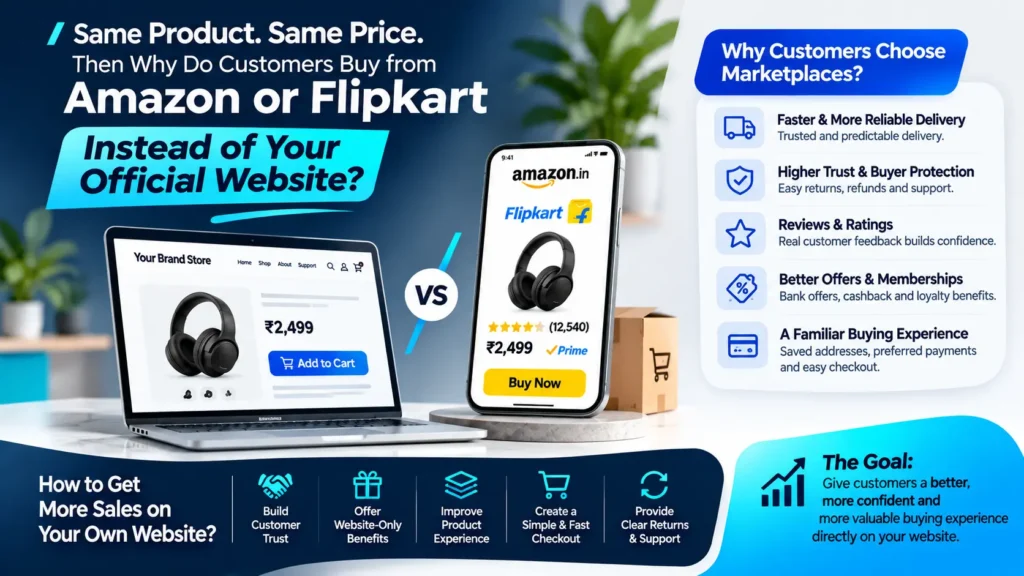
Imagine you own an ecommerce brand.
You have invested in product development, packaging, marketing, photography and website development. Your products are available on your official website, Amazon and Flipkart.
The product is exactly the same. The selling price is also the same.
But when customers are ready to purchase, they choose Amazon or Flipkart instead of your official website.
Have you ever wondered why?
This is one of the biggest challenges faced by many Direct-to-Consumer (D2C) brands and ecommerce businesses.
The problem is not necessarily your product or pricing. In many cases, it is the overall shopping experience, customer confidence and convenience.
Let’s understand what influences this decision and how businesses can improve their direct website sales.
1. Customer Trust: Familiar Platforms Have an Advantage
Think about your own online shopping behaviour.
When you purchase something from Amazon or Flipkart, you already know the platform. You are familiar with its checkout process, payment options, order tracking and customer support.
Now imagine visiting a relatively unknown ecommerce website.
Even if the product looks attractive, you might have questions:
- Is this website genuine?
- Will my payment be secure?
- Will I receive the actual product?
- What happens if the product is damaged?
- Can I return or replace it?
These questions can create hesitation.
What should businesses do?
Build trust directly on your website.
Consider displaying:
- Genuine customer reviews and testimonials.
- Clear company information and contact details.
- Secure payment options.
- Transparent return and refund policies.
- Product warranties and guarantees, where applicable.
- Customer support information.
A professional website should make customers feel confident before they reach the checkout page.
2. Product Reviews and Ratings Influence Buying Decisions
One major advantage of established marketplaces is the availability of customer reviews.
Customers can read experiences from other buyers, examine product photographs and understand potential product limitations.
A new ecommerce website may not have the same volume of customer feedback.
For example:
A customer finds headphones priced at ₹2,499 on both Amazon and your official website.
On Amazon, the customer sees thousands of reviews and an established rating.
On your website, there are no reviews.
Even though the product and price are identical, the customer may feel more comfortable purchasing from the marketplace.
What should businesses do?
Implement a proper product review system.
Encourage genuine customers to share their experiences after purchasing. Display verified purchase reviews, product photographs and helpful feedback.
Don’t underestimate the importance of social proof in ecommerce.
3. Delivery Speed and Shipping Experience Matter
Customers don’t only compare product prices. They also compare delivery experiences.
Established marketplaces may offer:
- Faster delivery options.
- Predictable delivery dates.
- Order tracking.
- Established logistics networks.
- Convenient delivery notifications.
If your official website displays an unclear delivery estimate or high shipping charges, customers may abandon their purchase.
What should businesses do?
Improve your delivery experience.
Integrate your ecommerce website with reliable shipping providers and provide:
- Estimated delivery dates.
- Real-time shipment tracking.
- Clear shipping charges.
- Automated delivery notifications.
- Easy access to shipping information.
The goal is to make purchasing directly from your website as convenient as possible.
4. Payment Convenience Can Change Purchase Decisions
Imagine a customer has already decided to purchase your product.
They proceed to checkout but discover that their preferred payment method is unavailable.
Or the checkout requires too many steps.
They may simply return to Amazon or Flipkart.
Payment convenience plays an important role in completing an online purchase.
What should businesses do?
Provide a smooth checkout experience with appropriate payment options, such as:
- UPI.
- Credit and debit cards.
- Net banking.
- Digital wallets.
- Cash on Delivery, where suitable.
- EMI options, where supported.
Also consider guest checkout, saved customer addresses and a mobile-friendly payment experience.
A complicated checkout can create unnecessary barriers between customers and completed purchases.
5. Marketplace Offers and Membership Benefits
Customers may already have access to bank discounts, cashback, memberships, reward points and special promotional offers on marketplaces.
Even when your product price is identical, the final amount payable may be different.
For example:
| Purchase detail | Brand website | Marketplace |
|---|---|---|
| Product price | ₹2,499 | ₹2,499 |
| Promotional discount | ₹0 | ₹150 |
| Shipping | ₹50 | Free |
| Effective price | ₹2,549 | ₹2,349 |
In this example, customers have a financial reason to choose the marketplace.
What should businesses do?
Instead of continuously reducing product prices, create additional value on your official website.
You can offer:
- Website-exclusive bundles.
- Loyalty programmes.
- Repeat-purchase discounts.
- Special offers for registered customers.
- Product customization.
- Exclusive product collections.
Give customers a reason to purchase directly from your brand.
6. Your Website May Be Missing Important Conversion Features
Many businesses invest heavily in website design but overlook the functionality that helps customers make purchasing decisions.
A visually attractive website is not necessarily a high-converting website.
Consider these features:
Product discovery
Customers should be able to find products through search, categories, filters and sorting.
Detailed product information
Display product specifications, images, sizes, variations, availability and important buying information.
Customer reviews
Allow customers to read genuine experiences before purchasing.
Transparent policies
Make shipping, returns, refunds, cancellation and warranty information easy to find.
Mobile-first shopping
Ensure customers can browse products and complete checkout comfortably on smartphones.
Order management
Provide order confirmation, tracking, notifications and customer account functionality.
These features should be considered during ecommerce website development, not added only after conversion problems appear.
7. Should Businesses Stop Selling on Amazon and Flipkart?
Absolutely not.
Marketplaces and official ecommerce websites serve different business purposes.
Marketplaces help businesses reach customers who are already searching for products.
An official website gives businesses greater control over their brand presentation, website experience, customer relationships and direct marketing activities.
A sensible ecommerce strategy is to use both channels effectively.
For example:
Amazon and Flipkart
- Product discovery.
- Access to marketplace customers.
- Additional sales channels.
- Marketplace-specific promotions.
Official Ecommerce Website
- Brand identity.
- Exclusive product collections.
- Direct customer relationships.
- Loyalty and repeat-purchase programmes.
- Custom shopping experiences.
- Direct marketing and customer engagement.
The objective should not necessarily be to move every customer away from marketplaces.
It should be to build an official website that gives customers a compelling reason to purchase directly.
8. How Technology Can Help Increase Direct Website Sales
The right ecommerce technology can help businesses improve the complete shopping experience.
Whether your business uses Magento, Shopify or WooCommerce, consider implementing the following capabilities.
1. Advanced Product Management
Organize product categories, attributes, variations, images and specifications effectively.
2. CRM Integration
Connect your ecommerce website with a CRM to manage customer enquiries, purchase history and follow-ups.
3. Inventory Synchronization
Synchronize stock information across your official website and marketplaces to reduce overselling and manual work.
4. Marketing Automation
Use email, SMS and WhatsApp workflows for order notifications, abandoned cart recovery and customer retention.
5. Analytics and Conversion Tracking
Understand where customers arrive from, which products they view, where they abandon checkout and which campaigns generate purchases.
6. Performance Optimization
Improve server response, caching, image delivery and frontend performance to create a smoother shopping experience.
7. Marketplace Integration
Connect your website with marketplace and inventory systems to simplify product, stock and order management.
Technology should support your business operations and make shopping easier for your customers.
9. A Practical Checklist for D2C Brands
Before investing more money in advertising, review your existing ecommerce website.
- Is your website building customer trust?
- Are genuine product reviews visible?
- Are product specifications complete?
- Is delivery information clearly displayed?
- Are return and refund policies easy to understand?
- Are multiple payment options available?
- Is checkout simple and mobile-friendly?
- Are website-exclusive benefits available?
- Is inventory synchronized across sales channels?
- Are analytics and conversion events configured correctly?
- Are abandoned carts being monitored?
- Is your customer support easily accessible?
These checks can help identify areas where your website experience needs improvement.
Conclusion: Customers Buy Convenience, Confidence and Value
Having an official ecommerce website is only the beginning.
Your website must provide a shopping experience that customers trust and enjoy.
Amazon and Flipkart have established customer relationships, familiar shopping processes and extensive marketplace infrastructure.
Competing with them does not mean copying everything they do.
It means understanding what customers value and building an experience that gives them a reason to choose your brand directly.
Remember:
Your product attracts customers. Your brand builds recognition. But your shopping experience helps turn visitors into buyers.
At MagentoGuru, we help businesses build, customize and optimize ecommerce platforms that support real business requirements.
Our services include:
- Magento 2 / Adobe Commerce Development.
- Shopify Store Development.
- WooCommerce Development.
- Custom Ecommerce Website Development.
- Multi-Vendor Marketplace Development.
- API and Third-Party Integrations.
- Website Performance Optimization.
Whether you are launching a new ecommerce business or improving an existing online store, choosing the right technology and development approach matters.
Build a better ecommerce experience with MagentoGuru.
Let’s build an ecommerce platform that works for your business and your customers.